
Border Leicester Sheep Demand Climbs as Tight Lamb Supply Reshapes 2026 Market
Spring lamb prices are being supported by tight Australian supply, with the Restocker Lamb Indicator jumping 132¢ to 1178¢/kg cwt in early September 2026. Mecardo reported the rise alongside a 62% week-on-week increase in young lamb yardings.
The deeper story is supply, flock rebuilding, seasonal conditions, and heavier carcases. Keep reading to see what the 2026 data means for producers.
Spring Lamb Market Surge & Restocker Demand
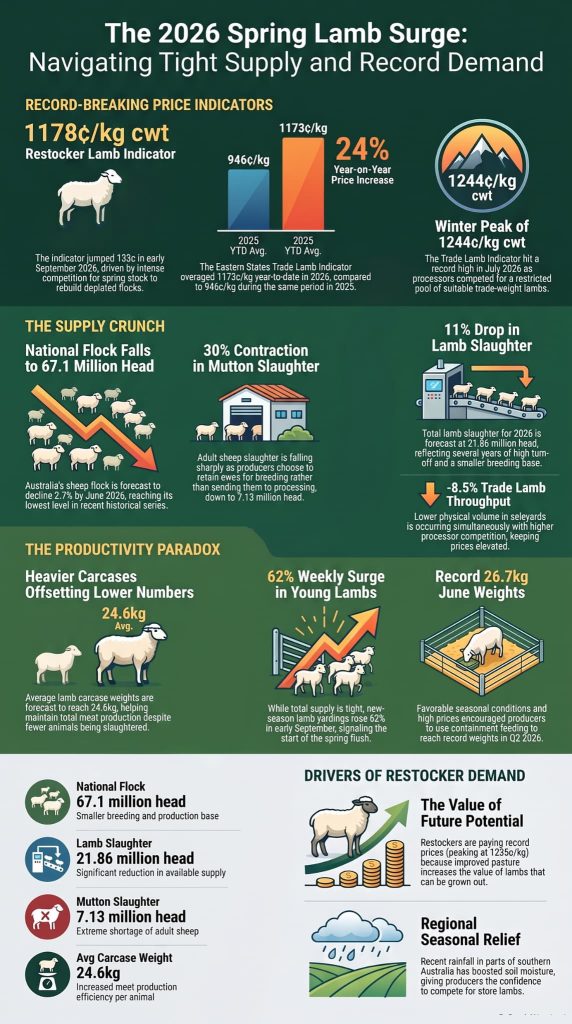
Why spring pricing can strengthen even as new-season lamb numbers begin to increase.
- +132¢ to 1178¢/kg cwt – Mecardo market commentary shows the Restocker Lamb Indicator’s weekly surge, pointing to strong competition for suitable spring stock.
- +62% – Young lamb supply increased week-on-week, showing that spring availability is beginning to lift even within a tight market.
- -2.7% to 67.1 million head – MLA’s 2026 sheep projections forecast Australia’s national flock to fall by 2.7% by 30 June 2026.
- -11% to 21.86 million head – Lamb slaughter was forecast to fall during 2026, reducing the number of animals available to processors.
- -30% to 7.13 million head – Mutton slaughter was forecast to contract sharply, reinforcing the shortage of adult sheep.
- 24.6kg – Average lamb carcase weight was forecast to reach 24.6kg in 2026, supported by genetics, feeding and processor demand for heavier stock.
- 1173¢/kg – The Eastern States Trade Lamb Indicator averaged 1173¢/kg year-to-date, compared with 946¢/kg in the same 2025 period, according to Mecardo.
- -8.5% – Trade lamb throughput declined year-on-year, adding evidence that physical supply remains constrained.
- 1244¢/kg cwt – The Trade Lamb Indicator reached a 2026 record peak at 1244¢/kg cwt during winter, according to MLA.
- 1235¢/kg cwt – The Restocker Lamb Indicator reached a record 1235¢/kg cwt in the week ending 28 June 2026.
Why Did The Restocker Lamb Indicator Surge +132¢ To 1178¢/kg Cwt?
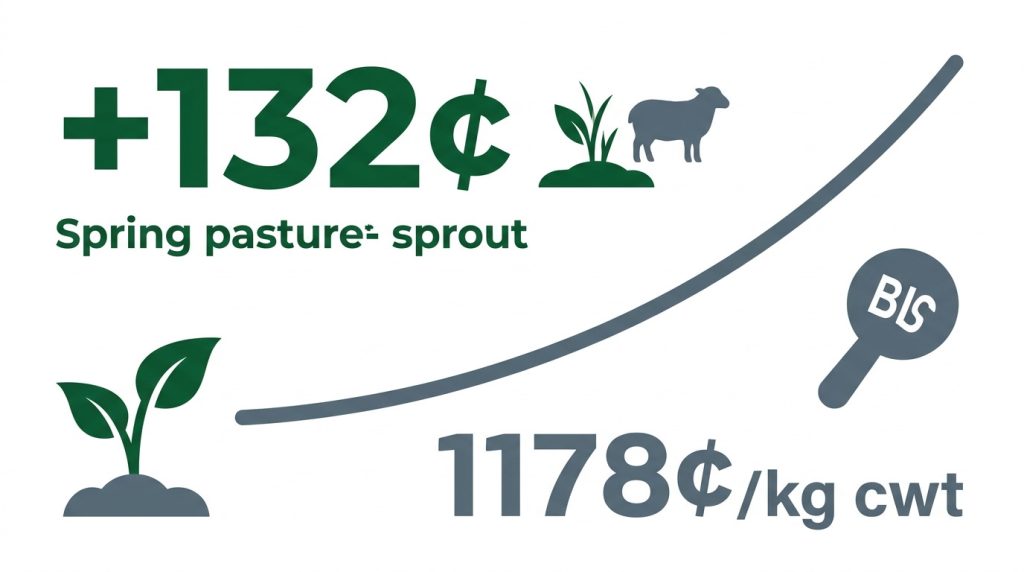
Tighter supply and strong competition for new-season lambs pushed the Restocker Lamb Indicator up 132¢ to 1178¢/kg cwt in the week reported on 4 September 2026.
Mecardo linked the move with the arrival of new-season lambs and improving seasonal confidence. Young lamb yardings rose 62% week-on-week, yet buyers increased bids rather than simply waiting for prices to soften.
That combination matters because spring supply can rise while the underlying flock remains small. MLA forecasts the national flock at 67.1 million head in 2026, after several years of elevated turn-off and difficult seasonal conditions.
The market therefore contains two different forces. More lambs are entering the saleyard, but fewer breeding animals and lower overall slaughter forecasts limit the depth of supply behind them.
- Restocker demand is competing for suitable young lambs.
- Seasonal improvement is increasing pasture-driven lamb growth.
- Flock rebuilding is restricting the number of animals available for immediate sale.
That helps explain why a spring flush does not automatically produce weaker lamb prices.
What is driving restocker demand?
Restocker demand reflects the value producers place on animals that can convert improving pasture into future finished lambs. Better seasonal conditions can make store lambs more attractive because the feed opportunity improves at the same time that breeding stock remains scarce.
The interaction between pasture availability, soil moisture, rainfall impact, and producer confidence is especially important. MLA says recent rainfall has provided relief in some areas, but conditions remain uneven across southern Australia.
The result is a market where the per-head valuation of a suitable lamb reflects both its immediate weight and its future production potential.
How Did Young Lamb Supply Increase +62% Week-On-Week?
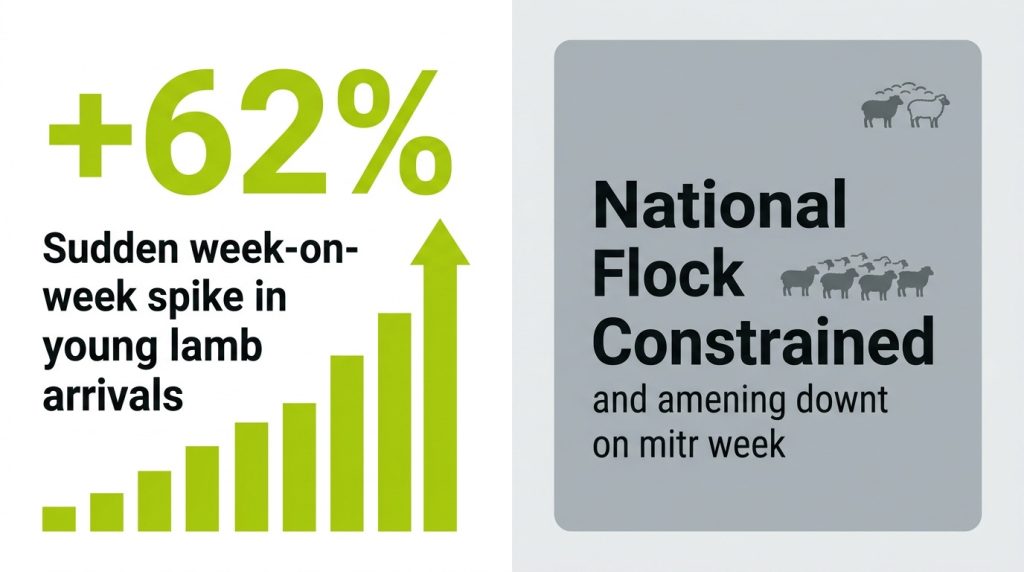
Young lamb supply increased 62% week-on-week as new-season lambs began arriving in greater numbers, but the increase represents a seasonal supply lift rather than a complete reversal of Australia’s tighter flock position.
Mecardo described the first major spring draft as attractive to buyers because the lambs arriving at yards had useful weight and quality. Wagga attracted additional buyers, while MLA saleyard reports showed keen processor and restocker competition.
The timing is significant. Producers with improving pasture can hold lambs longer, while buyers can see value in animals capable of reaching heavier finished weights.
The short-term sequence looks like this:
- Spring lamb supply rises 62% week-on-week.
- Buyers see more suitable new-season lambs.
- Restocker and processor competition remains active.
- The broader flock remains constrained.
That creates a mixed supply trend rather than a simple spring price correction.
What does the spring increase mean for producers?
The increase gives producers more marketing options, but it does not remove the structural shortage. MLA forecasts lamb slaughter at 21.86 million head in 2026, down 11%, after years of heavy turn-off.
For a producer entering the spring lamb market, timing therefore matters alongside weight. A light lamb sold early may capture strong restocker interest, while a heavier animal may benefit from processor demand for finished lambs.
Seasonal conditions also determine the economics. Better pasture availability can lower the need for purchased feed and support additional weight gain, while dry conditions can quickly change the value of holding animals.
Why Is The National Flock Forecast To Fall -2.7% To 67.1 Million Head?
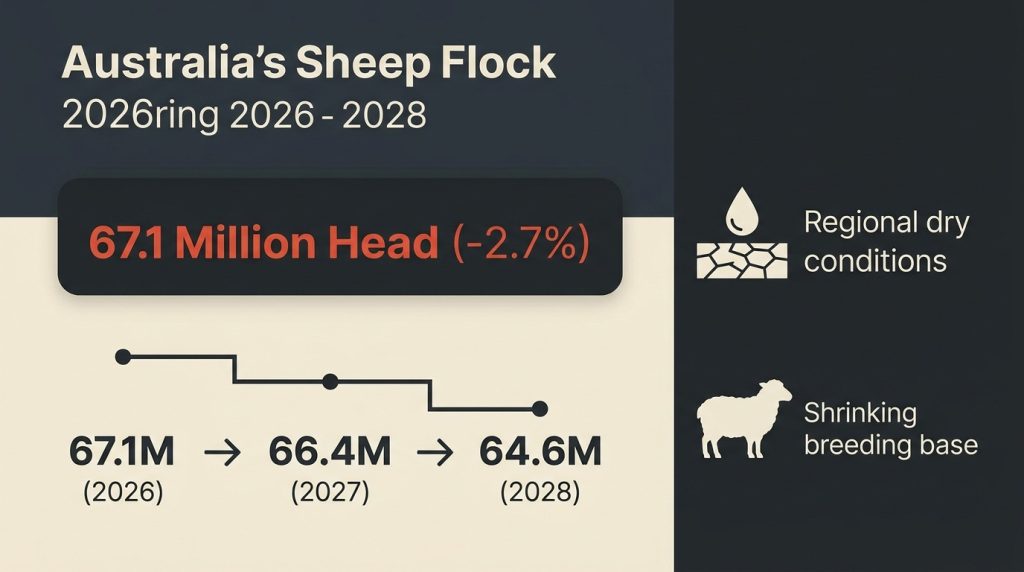
Australia’s national sheep flock is forecast to decline 2.7% to 67.1 million head by 30 June 2026, largely because several years of below-average rainfall and elevated turn-off have reduced the breeding base.
MLA identifies Victoria, South Australia, Tasmania and southern New South Wales among the regions affected by difficult seasonal conditions. Persistent feed and soil-moisture pressure has influenced producer decisions around retention, selling and flock rebuilding.
The supply effect extends beyond the current season. MLA forecasts the flock at 66.4 million head in 2027 and 64.6 million head in 2028, which would be the lowest level in its historical series.
| Market measure | 2026 data | What it indicates |
| National flock | 67.1 million head | Smaller breeding and production base |
| Lamb slaughter | 21.86 million head | Lower lamb supply |
| Mutton slaughter | 7.13 million head | Tighter adult sheep supply |
| Average lamb carcase weight | 24.6kg | More meat produced per lamb |
Lower female slaughter is also relevant. When producers retain ewes and other core breeding stock, fewer animals reach the saleyard immediately. That can strengthen breeding sheep demand and restrict finished lamb availability later.
The market is therefore moving through a rebuilding phase before the physical flock has actually rebuilt.
Why Is Lamb Slaughter Forecast To Fall -11% To 21.86 Million Head?
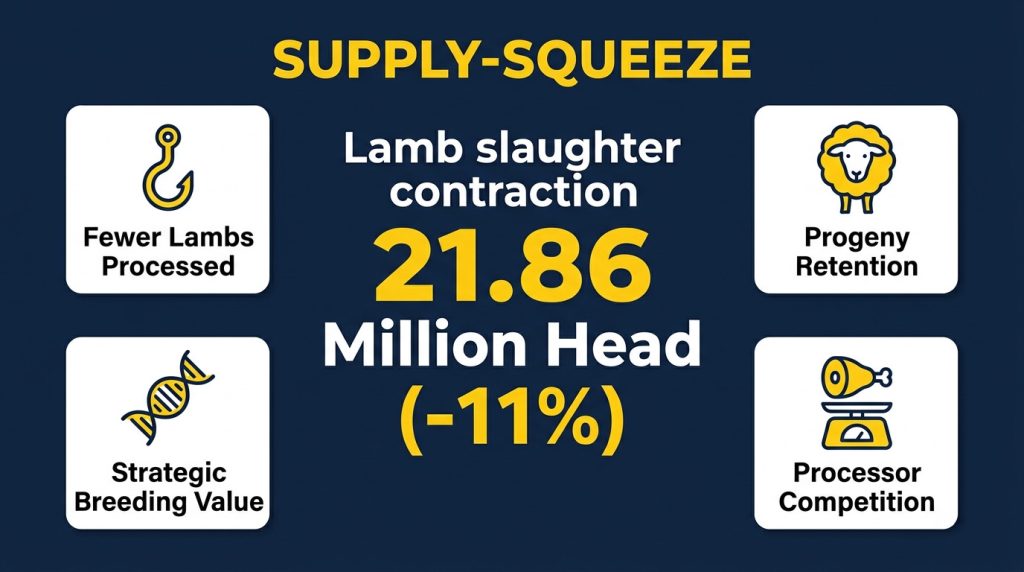
Lamb slaughter is forecast to fall 11% to 21.86 million head in 2026, reflecting the smaller flock and the effects of several years of high turn-off.
MLA says the earlier sale of ewe lambs and pregnant females has reduced future production capacity. Producers are now retaining more breeding stock where seasonal conditions allow, reducing the pool of lambs available for immediate processing.
That helps explain why record prices cannot be attributed to consumer demand alone. Supply is doing much of the work.
- Fewer lambs are entering processing.
- More producers are considering progeny retention.
- Breeding stock has greater strategic value.
- Processors compete for suitable finished lambs.
The supply squeeze also makes production efficiency more valuable. When fewer animals are available, additional kilograms of carcase weight can help maintain total meat production.
What does lower slaughter mean for market supply?
Lower slaughter means fewer lambs are moving through processors, saleyards and export supply chains. MLA forecasts lamb production to fall about 10% to 537,000 tonnes cwt, a smaller decline than the forecast fall in slaughter.
That gap is where carcase productivity becomes important. A producer who can turn available feed into additional saleable weight may offset some of the pressure created by lower animal numbers.
The same principle applies across the sheep market. Lower throughput can tighten supply, but heavier animals can prevent total production from falling as sharply as head counts suggest.
Why Is Mutton Slaughter Forecast To Fall -30% To 7.13 Million Head?
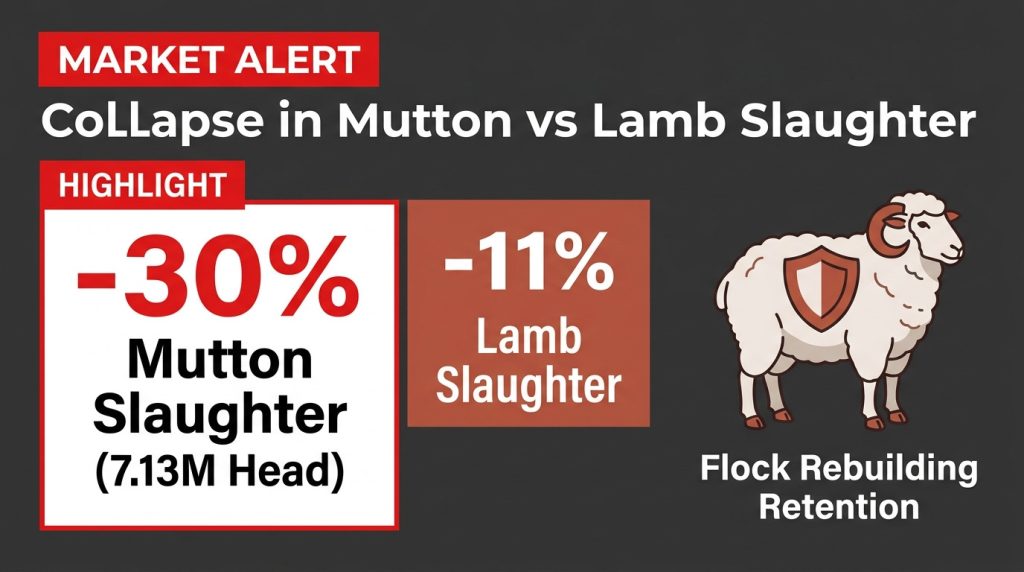
Mutton slaughter is forecast to fall 30% to 7.13 million head in 2026, showing that adult sheep supply is tightening faster than lamb supply.
The MLA projection reflects earlier heavy turn-off and a growing incentive to retain core breeding stock. The difference between lamb and mutton supply is important because flock rebuilding requires adult females, not simply more lambs moving through a livestock auction.
The supplied market findings also point to an unusually sharp recent contraction. MLA reported that national sheep slaughter fell 31% during FY2025-26.
- Fewer adult sheep are available.
- Breeding ewe retention becomes more valuable.
- Mutton supply becomes increasingly restricted.
- Restocker and breeding-stock markets become more sensitive to seasonal conditions.
This is why flock rebuilding can reinforce tight supply rather than immediately relieve it.
Why Could The Average Lamb Carcase Weight Reach 24.6kg In 2026?
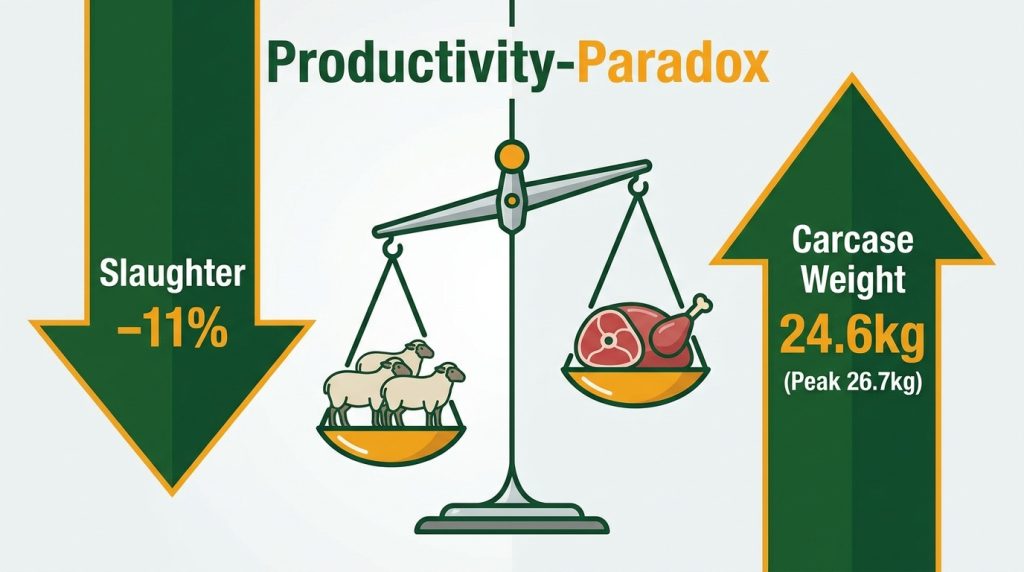
Average lamb carcase weight is forecast to reach 24.6kg in 2026, with MLA identifying genetic improvement, grain feeding and processor demand for heavier stock as contributors.
The contrast with slaughter numbers creates the productivity paradox. Lamb slaughter is forecast to fall 11%, yet production is expected to decline by only about 10%, reaching roughly 537,000 tonnes.
Recent actual results reinforce the direction. MLA reported a record national lamb carcase weight of 26.7kg in the June 2026 quarter as higher prices encouraged producers to feed lambs longer and use containment feeding.
| Supply pressure | Productivity response |
| Fewer lambs | Heavier carcases |
| Lower slaughter | Higher output per animal |
| Tight supply | Greater value from performance |
| Better pasture | More opportunity to finish lambs |
How does genetic improvement change the supply equation?
Genetic improvement does not replace flock numbers. It changes how much meat each available animal can produce.
MLA specifically connects ongoing genetic gains with higher carcase weights. LAMBPLAN, breeding values, growth selection and maternal performance can therefore become more relevant when producers are deciding which genetics to retain or purchase.
Of course, the available 2026 market data does not quantify a specific Border Leicester carcase-weight advantage. Any breed-specific performance claim should therefore be supported by verified trial or LAMBPLAN data before publication.
The broader evidence is still clear: heavier lambs are helping maintain production while the national flock contracts.
Why Is The Eastern States Trade Lamb Indicator Averaging 1173¢/kg?
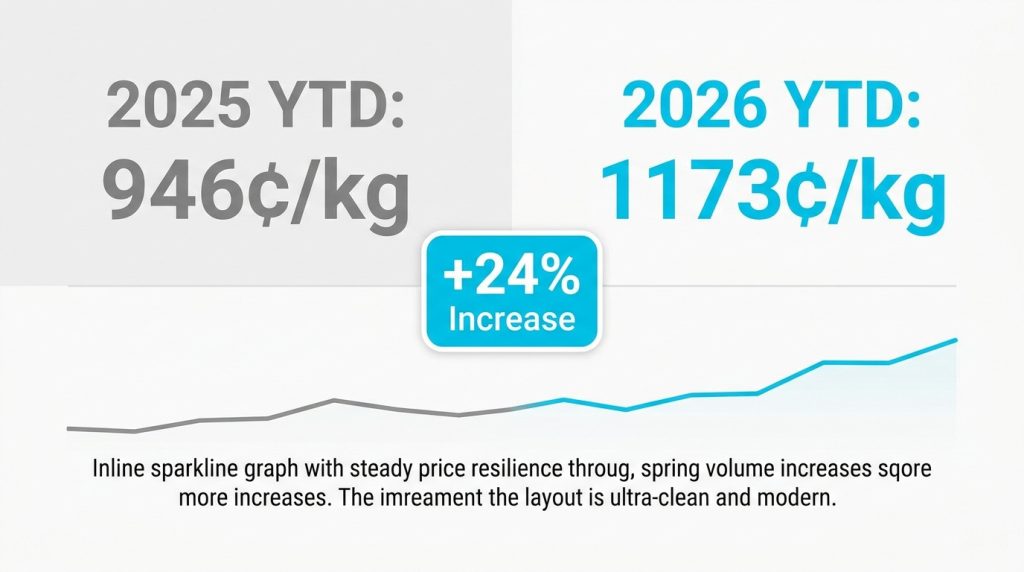
The Eastern States Trade Lamb Indicator averaged 1173¢/kg year-to-date in 2026, compared with 946¢/kg in the same 2025 period, a 24% increase.
Mecardo reported that the stronger average sits within a market where producers have been retaining lambs to heavier weights. Better seasonal conditions across much of southern Australia have provided feed for finishing, while historically high prices have increased the incentive to add weight before sale.
That combination changes the usual relationship between price and supply. More feed can support heavier lambs, but producers holding animals longer can also delay the flow of lighter lambs into the market.
The result is a tighter trade lamb pool even when total spring lamb availability begins to improve.
- 1173¢/kg is the 2026 YTD average.
- 946¢/kg was the comparable 2025 YTD average.
- The difference represents approximately 24% higher pricing.
- Trade lamb supply has simultaneously remained below historical levels.
The broader market confirms the pattern. MLA reported a quarterly record National Trade Lamb Indicator average of 1189¢/kg cwt in June 2026 as processors competed for tightening supply.
What Does The -8.5% Trade Lamb Throughput Decline Reveal?
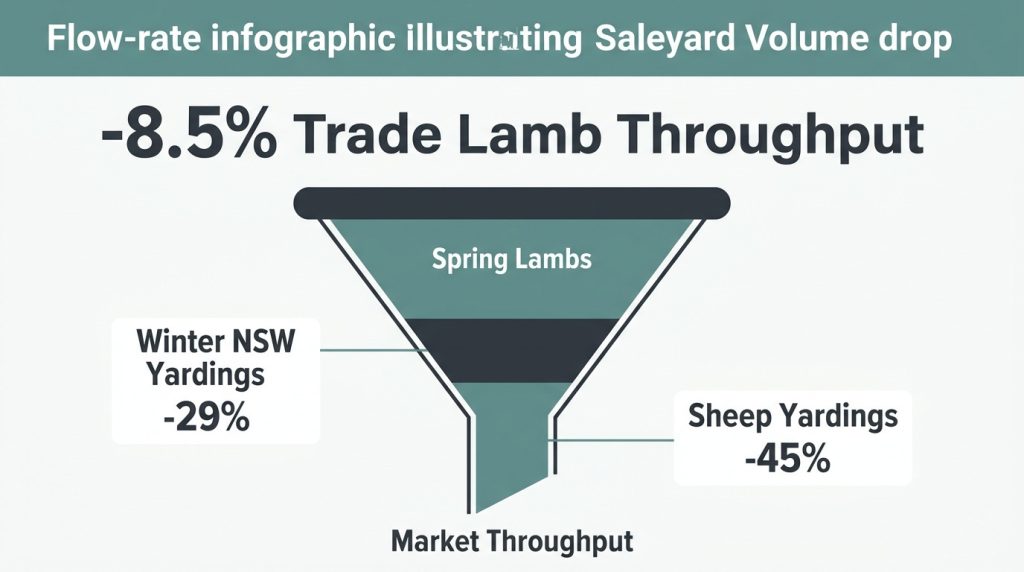
Trade lamb throughput falling 8.5% year-on-year indicates that fewer suitable lambs are reaching the market, helping explain why lamb prices have remained elevated despite improving spring supply.
The volume story matters because Mecardo found that producers were turning fewer lambs off as restockers while better seasonal conditions encouraged them to pursue heavier sale weights.
MLA’s market data shows how pronounced the contraction became during winter. NSW lamb yardings between June and August were 29% below the previous winter, while sheep yardings fell 45%.
The supply decline therefore extends beyond a single livestock auction or saleyard.
- Trade lamb throughput is down 8.5% year-on-year.
- National lamb slaughter is forecast at 21.86 million head.
- The Eastern States Trade Lamb Indicator averages 1173¢/kg.
- Lower availability is occurring alongside strong processor competition.
Why does throughput matter?
Throughput measures the physical flow of livestock into the market. It gives context to price movements that a cents-per-kilogram indicator alone cannot provide.
When throughput falls while prices remain high, the market is showing that available supply is limited relative to buyer requirements. When throughput rises sharply, price pressure can change quickly.
That distinction will matter as the spring lamb draft develops.
Why Did The Trade Lamb Indicator Peak At 1244¢/Kg Cwt?
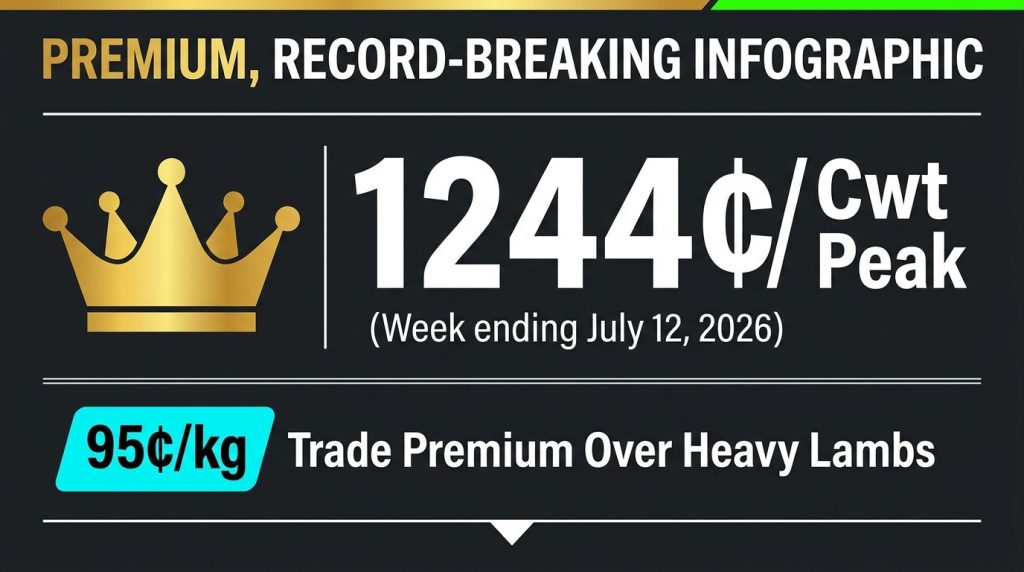
The Trade Lamb Indicator reached a record 1244¢/kg cwt during winter 2026, demonstrating how strongly processors competed for a restricted pool of suitable trade lambs.
MLA recorded the 1244¢/kg peak for the week ending 12 July 2026. Its market analysis linked the exceptional pricing to tightening sheepmeat supply, while favourable seasonal conditions encouraged producers to grow lambs to heavier weights.
The price peak also fits the broader production data. Lamb slaughter for FY2025-26 totalled 22.1 million head, down 15% year-on-year, while the June quarter recorded a record average lamb carcase weight of 26.7kg.
The market therefore rewarded weight at a time when the number of available lambs was falling.
What does the winter peak indicate?
- 1244¢/kg cwt represents the supplied winter record.
- Trade lamb supply remained below historical averages.
- Better pasture encouraged producers to pursue additional weight.
- Processor competition supported elevated pricing.
- Heavy lambs became an increasingly important part of the supply response.
MLA also reported that trade lambs carried a 95¢/kg cwt premium over heavy lambs during the week ending 10 July, the highest margin in more than five years.
That premium illustrates how individual categories can behave differently even within a generally strong sheep market.
Why Did The Restocker Lamb Indicator Peak At 1235¢/Kg Cwt?
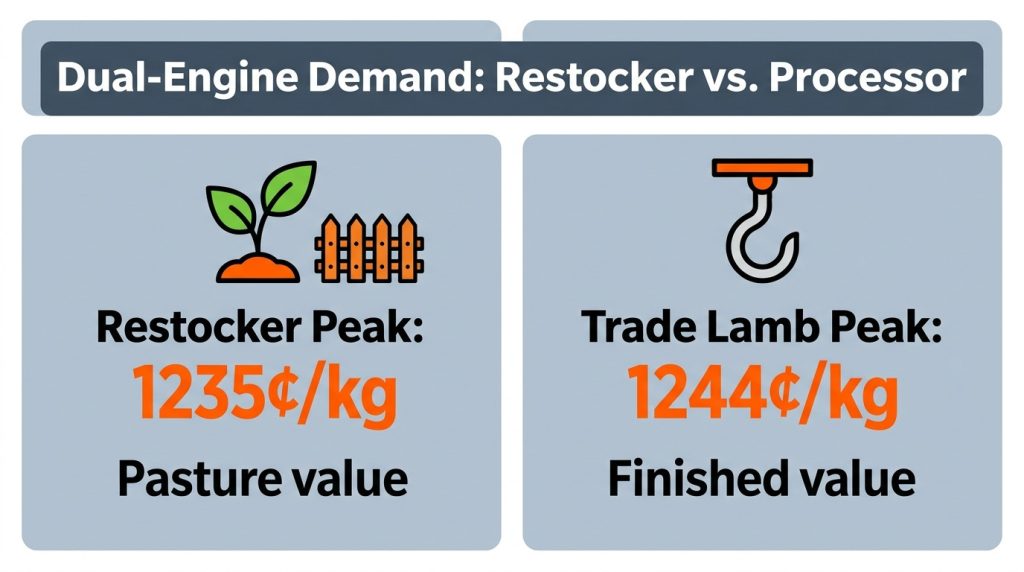
The Restocker Lamb Indicator reached a record 1235¢/kg cwt in the week ending 28 June 2026, reflecting intense competition for lambs suitable for future production.
The MLA record occurred shortly before the Trade Lamb Indicator reached its 1244¢/kg peak. That sequence shows that restocker and processor demand were both operating within a constrained supply environment rather than the market being driven by a single buyer group.
The distinction is useful for producers. A finished lamb has immediate carcase value, while a restocker lamb also has potential future value based on growth, pasture availability, reproductive performance and the buyer’s production system.
MLA’s June market wrap showed the Restocker Lamb Indicator reaching 1278¢/kg cwt on a daily basis on 24 June, although the weekly record cited in the data pack is 1235¢/kg.
How does the peak connect with spring conditions?
Restocker pricing reflects the interaction between animal availability and the expected value of feed. When pasture improves, buyers can justify paying more for suitable store lambs because the animals have a clearer pathway to additional weight.
The 2026 market illustrates that relationship:
- Stronger pasture availability increases the appeal of store lambs.
- Lower flock numbers restrict suitable supply.
- Progeny retention competes with sale decisions.
- Improving seasonal conditions can increase restocker urgency.
The later 62% increase in young lamb supply therefore does not erase the earlier restocker shortage. It changes the composition and timing of available stock.
FAQ
Border Leicester sheep are a dual-purpose sheep breed valued for both lamb and wool production. They are well muscled and produce rapidly growing market lambs with useful carcase qualities.
Their curly lustrous fleece is a medium to heavy-weight wool that can be used for spinning, garments, carpet yarn, and upholstery. This combination supports both meat and wool production.
A mature Border Leicester breed sheep can produce a substantial fleece, with common figures ranging from 8-12 pounds fleece and a 65-80% wool yield.
The fleece commonly has a staple length of 5-10 inches and measures about 30-38 micron wool. Border Leicester wool is also known for its lustrous wool, defined locks, and useful spinning qualities.
Border Leicester sheep are often considered easy keeping sheep because they are good foragers and have a reputation as a hardy sheep breed. They also have a calm temperament that can make routine handling easier.
As pasture kept sheep, they can make good use of available forage when nutrition, shelter, parasite control, and general flock management meet their needs.
Border Leicester ewes are valued for excellent mothering skills, heavy milk production, and high fertility. Their strong maternal nature can support healthy lamb growth, while their reputation for easy births can help reduce difficult lambing.
The ewes are also known for long-lasting udders, good birth weights, and the ability to provide effective care for their lambs.
Border Leicester wool is valued as handspinner wool because its pencil locks wool, lustre, and long staple provide useful spinning characteristics. The fleece can also be used for carpet yarn wool, upholstery wool, and durable garments wool.
Border Leicester wool can felt well and is easily dyed, giving spinners and textile makers several practical uses for the fleece.
What Comes Next For The Spring Lamb Market?
The spring lamb market is being shaped by tight supply, strong restocker demand, and heavier carcase weights. For producers, the key is looking beyond today’s price. Flock productivity, breeding stock availability, pasture conditions, and genetics will all influence decisions as the sheep industry rebuilds.
The next stage will depend on new-season lamb supply and seasonal conditions, but breeding decisions made now can shape future flock performance. Womboota Border Leicester can help producers assess genetics with a focus on productive breeding outcomes for the 2026 season. Contact Womboota Border Leicester about breeding genetics.